



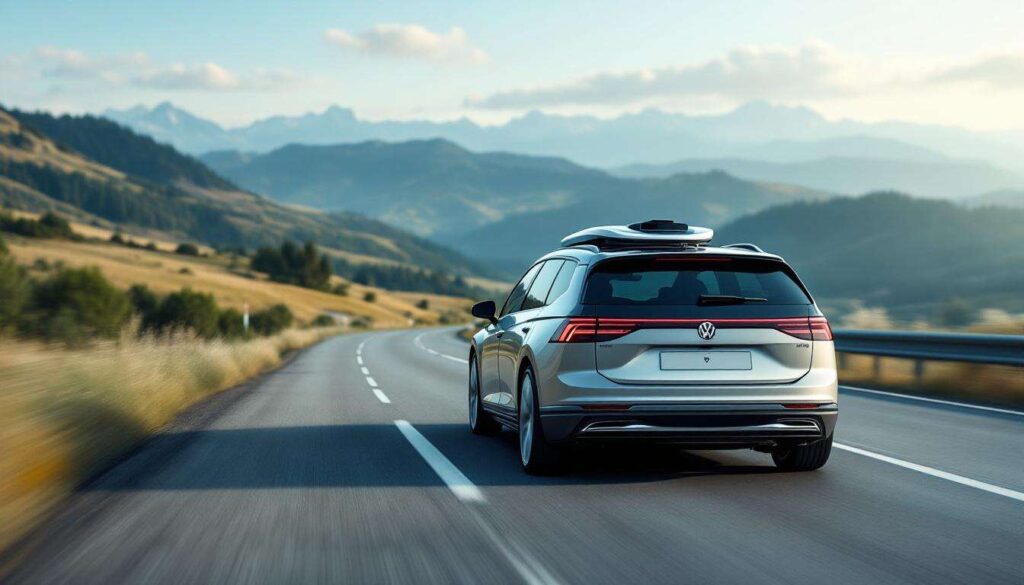
Volkswagen’s bold move to accelerate autonomous driving capabilities across Europe marks a significant shift in the automotive industry’s technological landscape. The German automaker has announced a comprehensive partnership with American electric vehicle manufacturer Rivian, leveraging the latter’s advanced software platform to power self-driving features in its vehicles. This collaboration represents one of the most ambitious cross-continental efforts to bring sophisticated autonomous technology to European roads, combining Volkswagen’s manufacturing expertise with Rivian’s cutting-edge digital architecture.
Strategic partnership between Volkswagen and Rivian
The foundation of the collaboration
The partnership between Volkswagen and Rivian extends beyond a simple technology licensing agreement. Volkswagen has committed substantial financial resources to this joint venture, establishing a framework that allows both companies to share development costs and technical expertise. The collaboration centers on Rivian’s proprietary software platform, which has demonstrated impressive capabilities in the American market through the company’s R1T pickup truck and R1S SUV models.
Key elements of the partnership include:
- Joint development of software architecture for autonomous driving systems
- Shared investment in research and development facilities
- Technology transfer agreements covering multiple vehicle platforms
- Collaborative testing programs across European markets
- Integration of Rivian’s electrical architecture into Volkswagen vehicles
Financial and operational structure
The financial commitment from Volkswagen demonstrates the automaker’s serious intent to compete in the autonomous driving space. The partnership structure allows for scalable implementation across Volkswagen’s diverse brand portfolio, including Audi, Porsche, and Škoda. This approach provides economies of scale that neither company could achieve independently.
| Partnership Aspect | Volkswagen Contribution | Rivian Contribution |
|---|---|---|
| Financial Investment | Capital funding and manufacturing resources | Software intellectual property |
| Technical Expertise | Vehicle integration and European market knowledge | Software development and autonomous systems |
| Market Access | European distribution networks | Digital platform architecture |
This strategic alliance positions both companies to address the rapidly evolving demands of European consumers and regulatory bodies. The complementary strengths of each partner create a foundation for sustained innovation in autonomous vehicle technology.
Rivian technology: an innovative solution for autonomous driving
Core technological advantages
Rivian’s software platform represents a fundamentally different approach to vehicle architecture compared to traditional automotive systems. The platform utilizes a centralized computing system rather than distributed electronic control units, enabling more sophisticated data processing and decision-making capabilities. This architecture supports over-the-air updates, allowing continuous improvement of autonomous driving features without requiring physical service visits.
The technical specifications include:
- High-performance computing units capable of processing sensor data in real-time
- Advanced sensor fusion algorithms combining camera, radar, and lidar inputs
- Machine learning models trained on diverse driving scenarios
- Redundant safety systems meeting automotive-grade reliability standards
- Cloud connectivity for fleet learning and continuous improvement
Software architecture and scalability
The modular nature of Rivian’s platform allows Volkswagen to implement features progressively across different vehicle segments. The software can scale from basic driver assistance systems to more advanced autonomous capabilities as regulatory frameworks evolve. This flexibility proves particularly valuable in the European context, where regulations vary significantly between countries.
Rivian’s approach to software development emphasizes continuous integration and testing, with simulation environments that replicate millions of miles of driving scenarios. This methodology accelerates development timelines while maintaining rigorous safety standards. The platform’s ability to learn from real-world data collected across entire vehicle fleets creates a competitive advantage that improves over time.
The technological foundation established through this partnership sets the stage for addressing the unique challenges present in European markets.
The challenges of autonomous driving in Europe
Regulatory complexity across member states
Europe presents a uniquely fragmented regulatory landscape for autonomous vehicles. Each European Union member state maintains some degree of autonomy in implementing autonomous driving regulations, creating a patchwork of requirements that manufacturers must navigate. The partnership must address varying standards for testing, certification, and deployment across multiple jurisdictions.
Major regulatory challenges include:
- Differing interpretations of liability in autonomous vehicle accidents
- Inconsistent data privacy requirements under GDPR and national laws
- Varying infrastructure standards for vehicle-to-infrastructure communication
- Multiple certification processes for safety systems
- Divergent approaches to testing and validation requirements
Infrastructure and environmental factors
European road infrastructure varies dramatically from the controlled highway environments where autonomous systems have achieved their greatest success. Medieval city centers with narrow streets, complex roundabouts, and aggressive driving styles in southern European countries present technical challenges distinct from American conditions. Weather conditions ranging from Scandinavian winters to Mediterranean summers require robust sensor performance across extreme variations.
| Challenge Category | Specific Issues | Technical Requirements |
|---|---|---|
| Urban Environments | Narrow streets, pedestrian zones | Enhanced object detection, low-speed maneuvering |
| Weather Conditions | Snow, fog, heavy rain | Redundant sensor systems, adaptive algorithms |
| Mixed Traffic | Cyclists, motorcycles, pedestrians | Sophisticated prediction models, defensive driving logic |
Public acceptance and trust
European consumers demonstrate varying levels of receptiveness to autonomous driving technology. Cultural attitudes toward technology adoption differ significantly between northern and southern European countries. Building public trust requires transparent communication about safety performance, extensive real-world testing, and clear demonstration of reliability advantages over human drivers.
These multifaceted challenges directly influence how the partnership will shape the broader automotive landscape.
Impact on the European automotive market
Competitive dynamics and market positioning
The Volkswagen-Rivian partnership reshapes competitive dynamics in the European automotive sector. Traditional manufacturers face pressure to accelerate their own autonomous driving programs or seek similar partnerships. The collaboration demonstrates that even established automakers recognize the value of specialized software expertise developed outside conventional industry structures.
Market implications include:
- Increased pressure on competitors to form strategic technology alliances
- Potential acceleration of autonomous feature deployment timelines
- Shift in value creation from hardware to software capabilities
- Growing importance of software talent in automotive employment
- Changing consumer expectations for vehicle technology features
Economic and employment considerations
The partnership’s economic impact extends beyond the two companies directly involved. European automotive suppliers must adapt to new requirements for sensors, computing hardware, and software integration services. The shift toward software-defined vehicles creates both opportunities and disruptions in traditional automotive supply chains. Employment patterns evolve as companies require more software engineers and data scientists relative to mechanical engineers.
Looking ahead, the partnership’s trajectory will determine whether this collaborative model becomes standard practice or remains an exception in the industry.
Future outlook for Volkswagen and Rivian
Deployment timeline and vehicle integration
Volkswagen plans a phased rollout strategy for Rivian-powered autonomous features across its European lineup. Initial implementations will focus on highway driving assistance and advanced parking capabilities, with more sophisticated urban autonomous driving features following as technology and regulations mature. The timeline accommodates the extended validation periods required by European safety authorities.
Long-term strategic implications
The success of this partnership could establish a template for future automotive industry collaborations. If Volkswagen successfully integrates Rivian’s technology across multiple brands and achieves commercial success with autonomous features, other manufacturers may pursue similar arrangements with software specialists. Conversely, integration challenges or regulatory obstacles could prompt reconsideration of the collaborative model.
Potential future developments include:
- Extension of the partnership to additional vehicle platforms and brands
- Expansion into adjacent technologies such as vehicle connectivity and energy management
- Possible joint ventures in manufacturing or service operations
- Technology licensing to third-party manufacturers
- Collaborative development of next-generation autonomous systems
The partnership’s evolution will depend on technological progress, regulatory developments, and market acceptance of autonomous driving features. Both companies have positioned themselves to adapt their collaboration as these factors evolve, maintaining flexibility while pursuing their shared vision for autonomous mobility in Europe.
The Volkswagen-Rivian partnership represents a pivotal moment in European automotive development, combining established manufacturing prowess with innovative software capabilities. Success requires navigating complex regulatory environments, overcoming technical challenges specific to European conditions, and building consumer trust in autonomous technology. The collaboration’s impact extends beyond the two companies involved, potentially reshaping competitive dynamics and establishing new models for automotive industry partnerships. As deployment progresses, the partnership will test whether cross-continental technology transfer can deliver on the promise of safer, more efficient autonomous driving across Europe’s diverse markets and regulatory frameworks.