



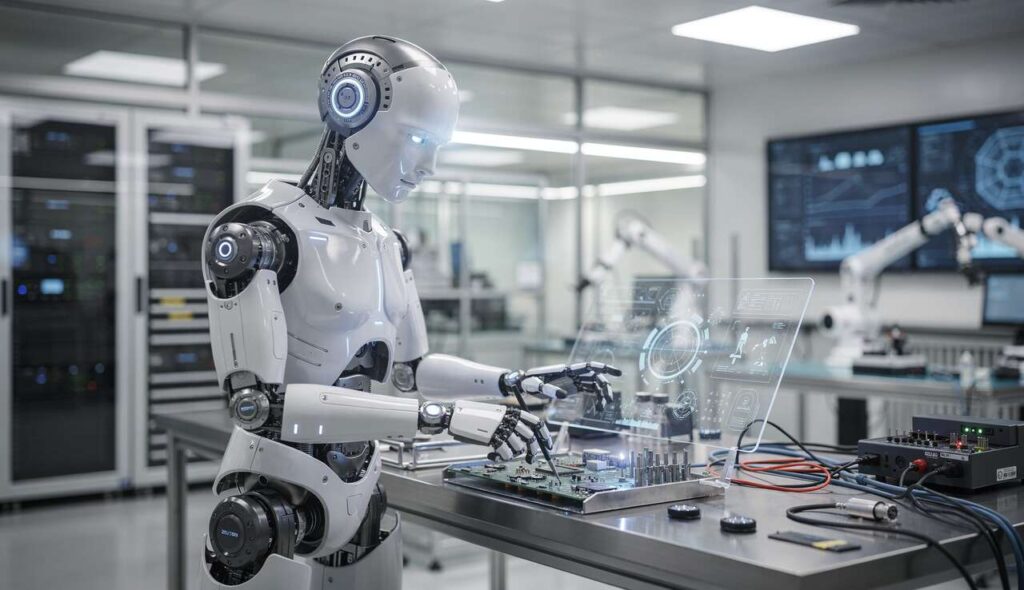
Alphabet has announced a significant organizational shift by integrating Intrinsic, its experimental robotics division originally launched as an independent moonshot project, into Google DeepMind. This strategic consolidation represents a pivotal moment in the company’s approach to artificial intelligence and robotics development, combining cutting-edge machine learning expertise with practical robotics applications. The move signals Alphabet’s commitment to accelerating progress in humanoid robot technology by leveraging the synergies between two of its most advanced technical divisions. By bringing together Intrinsic’s specialized robotics capabilities with DeepMind’s world-renowned AI research, the tech giant aims to create a more cohesive framework for developing intelligent robotic systems capable of operating in complex real-world environments.
Strategic merger between Intrinsic and Google DeepMind
Organizational restructuring details
The integration of Intrinsic into Google DeepMind marks a fundamental shift in how Alphabet manages its robotics initiatives. Previously operating under the X development lab umbrella, Intrinsic functioned as a semi-autonomous unit focused on developing software tools that would make industrial robots easier to program and deploy. The decision to fold this operation into DeepMind reflects a strategic reassessment of resource allocation and the recognition that combining these capabilities under one organizational structure could yield faster innovation cycles.
Key aspects of this merger include:
- Consolidation of research teams specializing in robotic manipulation and AI-driven control systems
- Integration of Intrinsic’s industrial robotics software platform with DeepMind’s reinforcement learning frameworks
- Unified leadership structure to streamline decision-making processes
- Shared infrastructure for testing and deploying robotic prototypes
- Combined talent pool of engineers, researchers, and robotics specialists
Rationale behind the consolidation
Alphabet’s leadership has emphasized that this merger is designed to eliminate redundancies and create a more efficient pathway from research to practical application. DeepMind has established itself as a leader in artificial intelligence through breakthroughs in areas such as protein folding prediction and game-playing algorithms. Meanwhile, Intrinsic developed expertise in making robots more adaptable to manufacturing environments through intuitive programming interfaces and perception systems. The combination of these complementary strengths positions the newly integrated unit to tackle the complex challenges inherent in humanoid robotics development.
This organizational change also reflects broader industry trends where companies are recognizing that advanced robotics requires both sophisticated AI capabilities and practical engineering solutions working in concert. The merger allows for more seamless collaboration between researchers developing theoretical models and engineers implementing those models in physical robotic systems.
Collaborative goals
Primary objectives of the unified division
The merged entity has articulated several ambitious targets that guide its research and development efforts. Central to these goals is the creation of humanoid robots capable of performing complex tasks in unstructured environments, particularly those designed for human interaction. The integration aims to accelerate progress by combining DeepMind’s expertise in creating AI systems that can learn from minimal data with Intrinsic’s practical experience in robotic deployment.
| Objective Area | Target Capability | Expected Timeline |
|---|---|---|
| Dexterous manipulation | Human-level object handling | 3-5 years |
| Environmental perception | Real-time 3D understanding | 2-3 years |
| Task learning | Few-shot learning capabilities | 2-4 years |
| Human interaction | Safe collaborative operation | 4-6 years |
Focus areas for research and development
The collaborative framework emphasizes several critical research domains that will receive concentrated attention and resources. These areas represent the technical frontiers where breakthroughs are most needed to enable practical humanoid robotics applications. The unified team is working to develop systems that can generalize learned behaviors across different contexts, a capability that remains elusive in current robotic systems.
Priority research initiatives include:
- Developing robust vision systems that enable robots to understand complex scenes with human-like comprehension
- Creating control algorithms that allow humanoid robots to maintain balance and navigate challenging terrain
- Advancing natural language processing capabilities for intuitive human-robot communication
- Building simulation environments that accurately model real-world physics for training purposes
- Implementing safety protocols that ensure reliable operation in proximity to humans
Impact on humanoid robotics development
Acceleration of research timelines
The organizational merger is expected to significantly compress development cycles by eliminating barriers that previously existed between separate research groups. When teams operate in isolation, valuable time is often lost in coordination efforts and knowledge transfer. By creating a unified structure, Alphabet enables researchers to build directly upon each other’s work, share datasets more efficiently, and rapidly iterate on experimental designs. This streamlined approach could potentially reduce the time required to move from conceptual breakthroughs to functional prototypes.
Enhanced resource allocation
Consolidating these divisions also allows for more strategic deployment of computational resources, which are critical for training advanced AI models. DeepMind’s infrastructure for running large-scale machine learning experiments can now be more readily accessed by teams working on robotics applications. Similarly, Intrinsic’s hardware testing facilities and robotic platforms become available to AI researchers who previously had limited access to physical systems for validation.
The resource synergies extend across multiple dimensions:
- Shared access to high-performance computing clusters for training neural networks
- Unified data repositories combining simulation results and real-world robotic interactions
- Cross-pollination of expertise between theoretical AI researchers and practical robotics engineers
- Consolidated vendor relationships for specialized sensors and actuators
- Joint intellectual property portfolio strengthening patent positions
Anticipated technological advancements
Breakthroughs in machine learning for robotics
The integration positions the combined team to make substantial progress in applying advanced machine learning techniques to robotic control problems. DeepMind’s track record with reinforcement learning and neural network architectures provides a foundation for developing robots that can learn complex behaviors through experience rather than explicit programming. This approach is particularly valuable for humanoid robots, which must master an enormous variety of movements and interactions that would be impractical to manually code.
Improvements in physical intelligence
A key focus area involves developing what researchers call physical intelligence, the ability of robots to understand and predict the consequences of physical interactions with their environment. This capability requires sophisticated models of physics, materials, and dynamics that go beyond purely visual or linguistic understanding. The merged organization is working to create AI systems that can reason about forces, friction, weight distribution, and other physical properties in ways that enable more capable and adaptive robotic behavior.
Expected technological advances include:
- Self-supervised learning systems that allow robots to improve through autonomous practice
- Transfer learning capabilities enabling skills learned in simulation to apply in real environments
- Multi-modal perception systems integrating vision, touch, and proprioceptive feedback
- Predictive models that anticipate object behavior during manipulation tasks
- Adaptive control systems that adjust to unexpected disturbances in real-time
Implications for the robotics industry
Competitive landscape shifts
Alphabet’s consolidation move sends a clear signal to competitors in the robotics and AI sectors about the company’s serious commitment to this domain. Other major technology companies and specialized robotics firms will likely need to reassess their strategies in response to this strengthened competitive position. The combined resources and talent concentration create formidable advantages in a field where progress often depends on having access to cutting-edge AI research and substantial computational infrastructure.
Potential market applications
The developments emerging from this merger could have far-reaching commercial implications across multiple industries. Humanoid robots with advanced capabilities could transform sectors ranging from healthcare to logistics, manufacturing to hospitality. The technology being developed has potential applications in environments where human-like form factors and dexterity provide advantages over specialized industrial robots.
| Industry Sector | Potential Application | Market Impact |
|---|---|---|
| Healthcare | Patient assistance and care support | High |
| Warehousing | Flexible item picking and sorting | Very high |
| Retail | Customer service and inventory management | Medium |
| Construction | Skilled task execution in variable environments | Medium |
Future outlook for Google DeepMind
Long-term strategic positioning
The absorption of Intrinsic represents a pivotal step in Google DeepMind’s evolution from a pure research organization to one with clearer pathways toward practical applications. This shift reflects broader recognition within Alphabet that breakthrough AI research must be coupled with concrete implementations to maximize value creation. The expanded mandate positions DeepMind to compete more directly with other organizations pursuing embodied AI and general-purpose robotic systems.
Roadmap for commercialization
While the immediate focus remains on research and development, the organizational structure now provides a clearer framework for eventual commercialization of resulting technologies. By housing both fundamental research and applied engineering within the same division, Alphabet creates conditions where innovations can more readily transition from laboratory demonstrations to market-ready products. This integrated approach could accelerate the timeline for bringing advanced humanoid robots to commercial deployment.
The path forward involves several key milestones that will indicate progress toward practical applications and market readiness for the technologies being developed under this new organizational structure.
The integration of Intrinsic into Google DeepMind represents a calculated strategic move by Alphabet to consolidate its robotics and artificial intelligence capabilities under unified leadership. By combining DeepMind’s theoretical AI expertise with Intrinsic’s practical robotics experience, the company has created a formidable organization positioned to accelerate humanoid robot development. The merger promises to deliver faster innovation cycles, more efficient resource utilization, and breakthrough capabilities in areas such as dexterous manipulation and physical intelligence. These advances carry significant implications for multiple industries where humanoid robots could provide transformative value. As the newly integrated division pursues its ambitious research agenda, the robotics industry will be watching closely to see how this consolidation translates into tangible technological progress and commercial applications.