



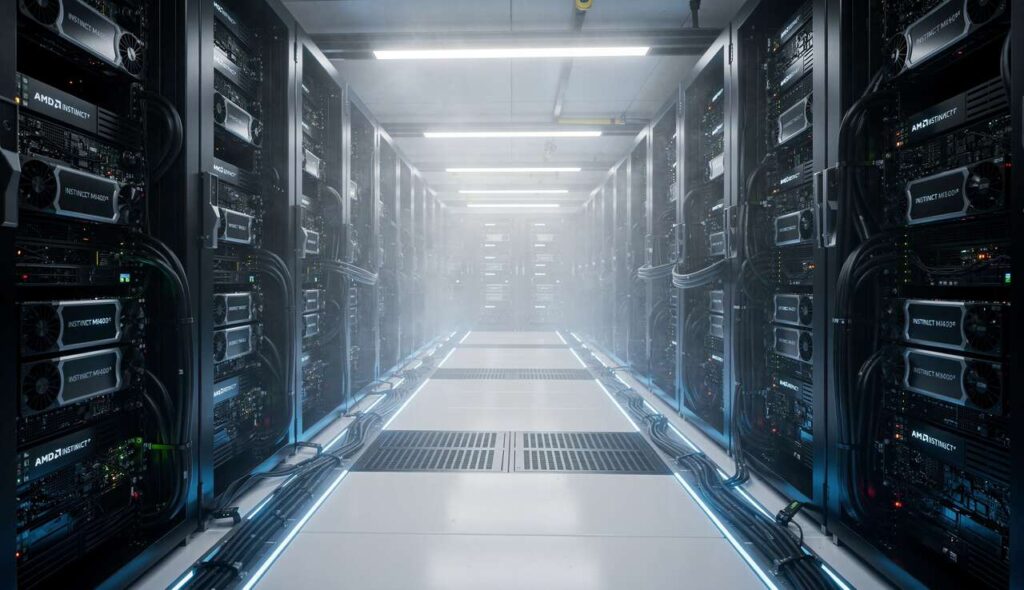
Meta has announced a significant investment in AMD’s latest Instinct MI400 graphics processing units, marking a deliberate effort to diversify its artificial intelligence training infrastructure. The social media giant’s decision reflects broader industry concerns about over-dependence on a single hardware supplier for critical AI workloads. This strategic move comes as companies worldwide seek alternatives to maintain competitive advantages in the rapidly evolving AI landscape while managing costs and supply chain risks.
Strategic investment of Meta in AMD GPUs
Scale and scope of the investment
Meta has committed to acquiring AMD Instinct MI400 GPUs as part of a comprehensive infrastructure expansion plan. The investment involves deploying these advanced processors across multiple data centers dedicated to AI research and development. This partnership represents one of the largest non-Nvidia GPU acquisitions in the tech industry, signaling Meta’s confidence in AMD’s ability to deliver enterprise-grade AI acceleration.
The deployment strategy encompasses several phases:
- Initial integration into existing AI training clusters for compatibility testing
- Gradual expansion across production environments for large language model training
- Development of optimized software frameworks tailored to AMD architecture
- Establishment of hybrid infrastructure combining multiple GPU vendors
Timeline and implementation strategy
Meta’s rollout plan extends over multiple quarters, allowing engineers to optimize workloads specifically for AMD hardware. The company has assembled dedicated teams to ensure seamless integration with existing AI frameworks and tools. This measured approach minimizes disruption to ongoing projects while building institutional knowledge around AMD’s architecture. The phased implementation also provides opportunities to benchmark performance against existing infrastructure and adjust deployment strategies accordingly.
Understanding the rationale behind this diversification requires examining Meta’s broader concerns about hardware dependency and supply chain resilience.
Reducing reliance on Nvidia: a priority for Meta
Risks of single-vendor dependency
Meta’s heavy reliance on Nvidia GPUs has created several strategic vulnerabilities that leadership sought to address. The concentration of AI training capacity on one vendor’s hardware exposes the company to supply constraints, pricing pressures, and limited negotiating leverage. Recent chip shortages and extended lead times have underscored these risks, prompting executives to pursue multi-vendor strategies for critical infrastructure components.
| Risk Factor | Impact on Operations | Mitigation Strategy |
|---|---|---|
| Supply constraints | Delayed AI project timelines | Multiple hardware sources |
| Pricing power | Increased infrastructure costs | Competitive procurement |
| Technology lock-in | Limited architectural flexibility | Diverse platform support |
Competitive considerations and market dynamics
The competitive landscape in AI development has intensified pressure on companies to optimize both performance and cost structures. Meta faces competition from other tech giants who are similarly investing billions in AI infrastructure. By diversifying GPU suppliers, Meta gains flexibility in resource allocation and reduces vulnerability to any single vendor’s product cycles or strategic decisions. This approach also encourages innovation through competition among hardware providers vying for Meta’s substantial purchasing power.
The technical specifications and capabilities of AMD’s newest offerings make them particularly attractive for Meta’s specific AI workloads.
The advantages of AMD Instinct MI400 GPUs for AI
Technical specifications and performance metrics
The AMD Instinct MI400 series delivers substantial improvements over previous generations in key areas relevant to AI training. These processors feature enhanced memory bandwidth, increased computational throughput, and architectural optimizations specifically designed for deep learning workloads. The chips incorporate advanced packaging technologies that enable higher density deployments and improved power efficiency compared to earlier AMD offerings.
Key technical advantages include:
- High-bandwidth memory architecture supporting large model parameters
- Enhanced matrix multiplication units optimized for transformer models
- Improved interconnect technologies for multi-GPU scaling
- Advanced cooling solutions enabling sustained performance under load
Cost-effectiveness and total ownership considerations
Beyond raw performance, the MI400 GPUs offer compelling economic advantages for large-scale deployments. The combination of competitive pricing, power efficiency, and performance density creates favorable total cost of ownership calculations for Meta’s massive infrastructure requirements. Energy consumption represents a significant ongoing expense for data center operations, making the MI400’s efficiency improvements particularly valuable. Additionally, AMD’s willingness to provide customization options and dedicated support for major customers enhances the value proposition beyond standard product offerings.
These technical and economic factors directly influence how Meta structures its AI training infrastructure going forward.
Impact on AI training infrastructure at Meta
Architectural changes and optimization requirements
Integrating AMD GPUs necessitates substantial modifications to Meta’s software stack and training pipelines. Engineers must adapt existing code to leverage AMD’s ROCm platform and ensure compatibility with frameworks like PyTorch and TensorFlow. This process involves profiling workloads, identifying bottlenecks, and implementing architecture-specific optimizations. The company has invested in building expertise around AMD hardware, creating internal documentation, and developing best practices for hybrid GPU environments.
Performance benchmarks and real-world results
Early testing indicates that properly optimized workloads on MI400 GPUs can achieve competitive performance with existing solutions for many AI training tasks. Meta’s internal benchmarks focus on metrics most relevant to production workloads, including time-to-accuracy for large language models, throughput for recommendation systems, and efficiency for computer vision tasks. While some workloads show clear advantages, others require additional optimization work to reach parity with mature Nvidia-based implementations.
| Workload Type | Performance Comparison | Optimization Status |
|---|---|---|
| Large language models | Competitive throughput | Ongoing refinement |
| Computer vision | Strong performance | Production ready |
| Recommendation systems | Favorable efficiency | Advanced optimization |
These infrastructure changes have broader implications that extend beyond Meta’s internal operations.
Consequences for the AI technology market
Competitive dynamics in the GPU market
Meta’s investment provides significant validation for AMD’s AI ambitions and may encourage other large technology companies to explore similar diversification strategies. This shift could reshape competitive dynamics in the GPU market, potentially moderating Nvidia’s dominant position in AI acceleration. Increased competition typically drives innovation, potentially accelerating development cycles and creating more options for organizations of all sizes seeking AI infrastructure solutions.
Industry-wide implications and ripple effects
The move signals to the broader market that viable alternatives to Nvidia exist for demanding AI workloads when properly implemented. This perception shift could influence procurement decisions across industries, from cloud service providers to research institutions. Equipment manufacturers, software developers, and system integrators are likely to increase their focus on AMD compatibility, creating a more robust ecosystem around alternative GPU platforms. The increased attention may also attract talent and investment to AMD’s AI initiatives, further strengthening their competitive position.
Industry observers and key stakeholders have responded to Meta’s announcement with varying perspectives on its significance.
Reactions and perspectives of industry players
Analyst assessments and market forecasts
Technology analysts view Meta’s investment as a watershed moment for the AI hardware market. Financial analysts have adjusted their projections for both AMD and Nvidia, anticipating shifts in market share and competitive positioning. Some experts predict that this move will encourage accelerated product development cycles as vendors compete more intensely for major customer deployments. Others caution that Nvidia’s ecosystem advantages and software maturity will continue to provide substantial competitive moats despite increased competition.
Responses from competing technology companies
Other major technology companies have acknowledged watching Meta’s AMD deployment with interest, with several indicating they are evaluating similar diversification strategies. Cloud providers have noted the importance of offering customers multiple GPU options to meet varying performance, cost, and availability requirements. Hardware startups focused on AI acceleration see Meta’s move as validation that the market is receptive to alternatives, potentially improving their ability to attract investment and customers. Meanwhile, Nvidia has emphasized its continued innovation pipeline and the depth of its software ecosystem as enduring competitive advantages.
Meta’s strategic pivot toward AMD GPUs represents a significant development in AI infrastructure planning, driven by practical considerations around supply chain resilience, cost optimization, and competitive positioning. The investment demonstrates that major technology companies are willing to undertake substantial integration efforts to reduce dependency on single hardware vendors. As AMD’s MI400 processors prove their capabilities in production environments, the AI hardware landscape may evolve toward greater diversity and competition. This shift could ultimately benefit the broader industry by fostering innovation, improving availability, and providing organizations with more options for building AI infrastructure tailored to their specific requirements and constraints.