



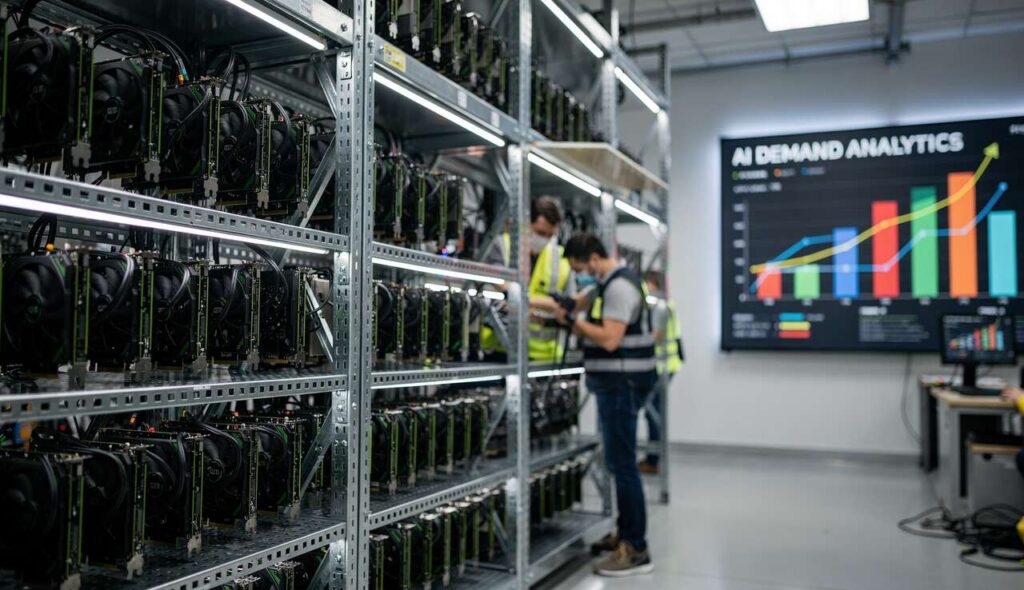
Graphics processing units have become the cornerstone of modern artificial intelligence infrastructure, and the semiconductor industry faces unprecedented challenges in meeting surging demand. Nvidia, the dominant player in AI chip manufacturing, recently issued a stark warning about supply constraints that will persist through at least two additional fiscal quarters. This announcement sends ripples through technology sectors worldwide, as companies racing to deploy AI capabilities confront the reality of limited hardware availability. The shortage reflects a fundamental mismatch between production capacity and the explosive growth of generative AI applications, data center expansions, and machine learning workloads that require increasingly powerful computational resources.
Current state of the GPU market
Supply constraints across product lines
The GPU market currently operates under severe supply limitations that affect both consumer and enterprise segments. Nvidia’s high-performance chips, particularly the H100 and A100 series, remain in critically short supply despite the company’s efforts to ramp up production. Lead times for enterprise orders have stretched to several months, forcing organizations to adjust their infrastructure deployment schedules accordingly.
The supply situation manifests differently across various market segments:
- Data center GPUs experience the most acute shortages, with waiting lists extending well into subsequent quarters
- Professional workstation cards face moderate constraints but remain more accessible than data center variants
- Consumer gaming GPUs show improved availability compared to previous periods, though premium models still sell out quickly
- Edge computing and embedded solutions encounter sporadic shortages depending on specific configurations
Manufacturing bottlenecks and capacity challenges
The production challenges stem from multiple interconnected factors within the semiconductor supply chain. Advanced packaging technologies required for cutting-edge AI chips present particular difficulties, as only a handful of facilities worldwide possess the necessary equipment and expertise. Taiwan Semiconductor Manufacturing Company, Nvidia’s primary foundry partner, operates at near-maximum capacity while simultaneously serving other major technology companies.
| Production stage | Capacity utilization | Bottleneck severity |
|---|---|---|
| Wafer fabrication | 95% | High |
| Advanced packaging | 98% | Critical |
| Testing and validation | 92% | Moderate |
| Final assembly | 90% | Moderate |
These manufacturing constraints create a cascading effect throughout the entire production pipeline, limiting the industry’s ability to respond quickly to demand surges. Understanding these supply limitations provides essential context for examining what drives such extraordinary demand for AI processing capabilities.
Increasing demand for AI chips
Generative AI applications driving unprecedented growth
The emergence of large language models and generative AI platforms has fundamentally transformed computational requirements across industries. Training sophisticated AI models demands massive parallel processing capabilities that only specialized GPUs can deliver efficiently. Companies developing AI services require thousands of interconnected chips working simultaneously, creating demand levels that far exceed historical patterns.
Generative AI deployment spans multiple application categories:
- Natural language processing systems powering chatbots, content generation, and translation services
- Image and video synthesis tools enabling creative applications and synthetic media production
- Code generation platforms assisting software developers with automated programming tasks
- Scientific research applications accelerating drug discovery, climate modeling, and materials science
Enterprise adoption accelerating infrastructure investments
Organizations across sectors recognize AI as a strategic imperative rather than an experimental technology. This shift in perception drives substantial capital investments in GPU-powered infrastructure. Major cloud service providers continuously expand their AI-capable data centers, while enterprises build private infrastructure to maintain control over proprietary data and models.
The financial commitment to AI infrastructure reflects confidence in long-term returns. Technology companies allocate billions of dollars quarterly toward GPU acquisitions, with some organizations placing orders that exceed their immediate needs to secure future supply. This forward-purchasing behavior further tightens available inventory and extends delivery timelines for other customers.
The sustained demand pressure creates significant implications for industries dependent on GPU availability, affecting competitive dynamics and strategic planning across multiple sectors.
Impact on technology industries
Cloud computing providers facing capacity constraints
Major cloud platforms struggle to satisfy customer demand for GPU-accelerated instances. Amazon Web Services, Microsoft Azure, and Google Cloud all report extended waiting periods for certain high-performance configurations. These limitations force customers to either accept less powerful alternatives, distribute workloads across multiple regions, or delay project timelines until capacity becomes available.
The shortage affects cloud providers’ competitive positioning, as GPU availability becomes a differentiating factor in customer acquisition and retention. Providers with secured chip allocations gain advantages in attracting AI-focused enterprises, while those facing tighter constraints risk losing market share to better-supplied competitors.
Startups and research institutions navigating limited access
Smaller organizations and academic institutions face particularly acute challenges in obtaining necessary hardware. Unlike established technology giants with substantial purchasing power and existing supplier relationships, emerging companies often find themselves at the back of allocation queues. This disparity creates potential barriers to innovation, as promising AI research projects may stall due to insufficient computational resources.
The access inequality manifests in several ways:
- Extended procurement timelines that disrupt research schedules and funding cycles
- Higher effective costs as organizations resort to premium cloud computing rates
- Competitive disadvantages for startups unable to match infrastructure capabilities of established players
- Geographic disparities as certain regions receive priority in chip allocation strategies
Alternative architecture exploration and diversification
Hardware constraints motivate technology companies to explore alternative processing architectures. Some organizations invest in custom chip development, following patterns established by major technology firms that designed proprietary AI accelerators. Others investigate specialized processors optimized for specific workload types, potentially reducing dependence on general-purpose GPUs.
This diversification trend could reshape the semiconductor landscape over time, though Nvidia’s technological lead and software ecosystem advantages maintain its dominant position for the foreseeable future. How the company responds strategically to persistent supply challenges will significantly influence market dynamics going forward.
Nvidia’s strategies facing the shortage
Production expansion and foundry partnerships
Nvidia pursues multiple approaches to increase chip availability. The company works closely with manufacturing partners to secure additional production capacity, though expanding semiconductor fabrication capabilities requires substantial time and capital investment. New fabrication facilities typically require several years from groundbreaking to production readiness, limiting short-term supply improvements.
Strategic initiatives include:
- Negotiating expanded wafer allocations with existing foundry partners
- Qualifying additional manufacturing facilities for certain product lines
- Investing in advanced packaging capacity through partnerships and direct capital commitments
- Optimizing chip designs to improve manufacturing yields and production efficiency
Product portfolio optimization and allocation strategies
The company implements sophisticated allocation mechanisms to distribute limited supply across customer segments. Priority systems favor customers with long-term commitments and strategic importance, while maintaining sufficient availability for diverse market participants. This balancing act requires continuous adjustment as demand patterns evolve and production capacity fluctuates.
Nvidia also accelerates development of more diverse product offerings, creating options at various performance and price points. This portfolio expansion helps address different customer needs with appropriate solutions, potentially easing pressure on the most constrained flagship products.
These strategic responses position the company for the challenging market conditions anticipated in upcoming quarters, where supply-demand imbalances will continue shaping industry dynamics.
Forecast for the upcoming quarters
Supply timeline projections and uncertainty factors
Nvidia’s guidance indicates that tight supply conditions will persist through at least two additional fiscal quarters before meaningful improvement occurs. This timeline assumes stable manufacturing operations and successful execution of capacity expansion plans. However, numerous variables could alter this projection, including geopolitical developments, supply chain disruptions, or unexpected technical challenges in production scaling.
| Quarter | Expected supply improvement | Demand trajectory |
|---|---|---|
| Current quarter | Minimal | Accelerating |
| Next quarter | Slight increase | Sustained high levels |
| Following quarter | Moderate improvement | Continued growth |
| Subsequent periods | Gradual normalization | Stabilizing at elevated baseline |
Market dynamics and competitive landscape evolution
The extended shortage period will likely accelerate certain market trends. Alternative chip architectures may gain traction as organizations seek any available computational resources. Competitive pressures intensify as rival semiconductor companies attempt to capture market share by offering more readily available alternatives, though matching Nvidia’s performance and software ecosystem presents substantial challenges.
Long-term implications include potential structural changes in how organizations approach AI infrastructure planning. Companies may adopt more diversified hardware strategies, maintain larger buffer inventories, or establish earlier procurement commitments to ensure supply security. These behavioral shifts could persist even after supply constraints ease, permanently altering purchasing patterns in the AI chip market.
The semiconductor industry stands at a pivotal juncture where supply realities constrain the pace of AI advancement. Nvidia’s position as the primary supplier of AI-capable GPUs places the company at the center of technology infrastructure development, while simultaneous supply limitations create opportunities for innovation in alternative approaches. The coming quarters will test the resilience of organizations dependent on GPU availability and potentially reshape competitive dynamics across multiple technology sectors. As manufacturing capacity gradually expands and demand patterns mature, the market will eventually find a new equilibrium, though the timeline remains uncertain and dependent on numerous complex factors beyond any single company’s control.