
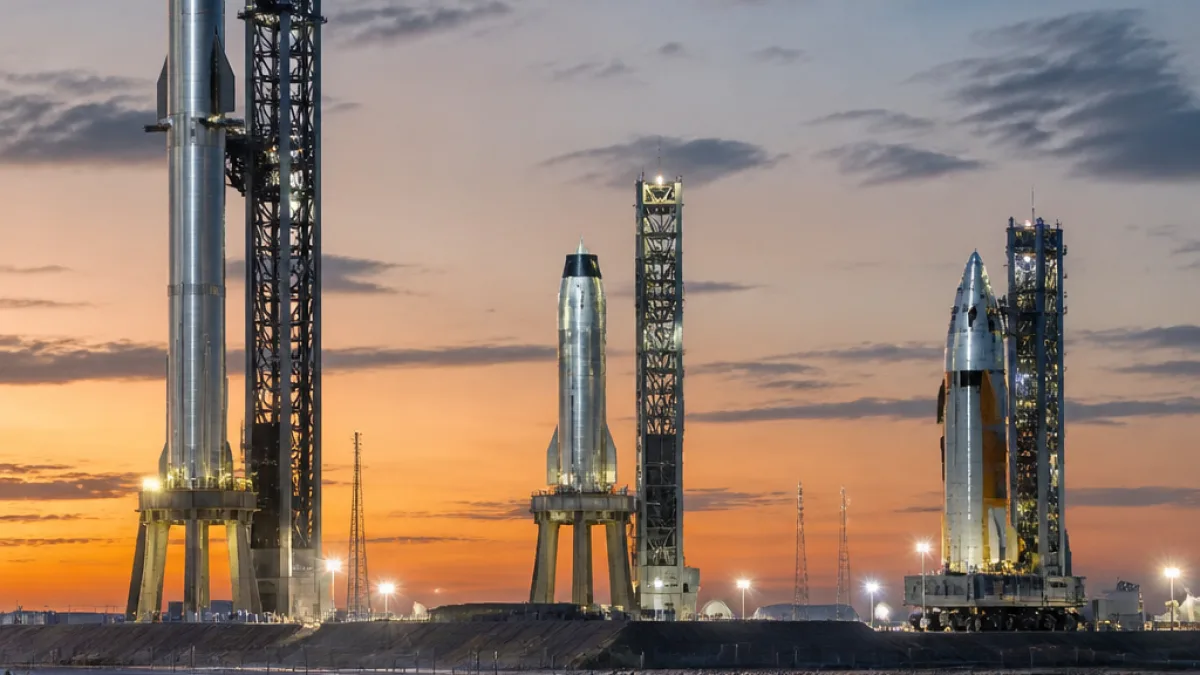
NASA plans to conduct an orbital docking exercise next summer that will place two commercial lunar landers in Earth orbit for astronauts to visit the spacecraft, Administrator Jared Isaacman said Friday.
Artemis III will stay in Earth orbit
Isaacman said the mission designated Artemis III will not include a lunar landing. Instead, four astronauts — three NASA crew members and one Italian — will launch aboard the agency’s Orion capsule and perform docking practice with two different lunar landers operated by private companies.
- Blue Origin’s Blue Ghost will launch first and be docked with Orion about 270 miles (435 kilometers) above Earth.
- SpaceX’s Starship will launch into a slightly lower orbit for a subsequent docking maneuver.
- The operation will require three launches in quick succession from Cape Canaveral, Isaacman said.
“It’s about our own history. It’s a playbook this agency knows really well, the same playbook that went from Apollo 7 splashdown to Apollo 11 in just nine months,” Isaacman said during a news conference at Kennedy Space Center.
Isaacman framed the effort as an acceleration of agency work, saying NASA is cutting meeting time and bureaucratic delays to match a faster tempo as commercial partners race to meet development milestones. He compared the approach to the intense cadence of activity during the Apollo era.
Artemis IV remains targeted for a crewed lunar landing in 2028
Despite the orbital nature of Artemis III, NASA officials continue to plan Artemis IV as the program’s first crewed lunar landing since Apollo, with a target in 2028. Isaacman said the agency will keep its options open before selecting between SpaceX and Blue Origin for the Artemis IV lunar lander contract.
The announcement follows the successful Artemis II flight around the moon earlier this year, which carried four astronauts on humanity’s first lunar trip in more than half a century, according to Isaacman. He said the upcoming missions will test procedures and hardware that will support future surface operations.
The planned sequence — Orion launching with the crew, docking with Blue Ghost, then with Starship — is intended to give astronauts and engineers practice with rendezvous, docking and interoperability between NASA’s spacecraft and commercial landers ahead of a crewed lunar descent. Isaacman emphasized that multiple companies are working around the clock to meet NASA schedules as the agency expands its workforce to support an accelerated tempo.