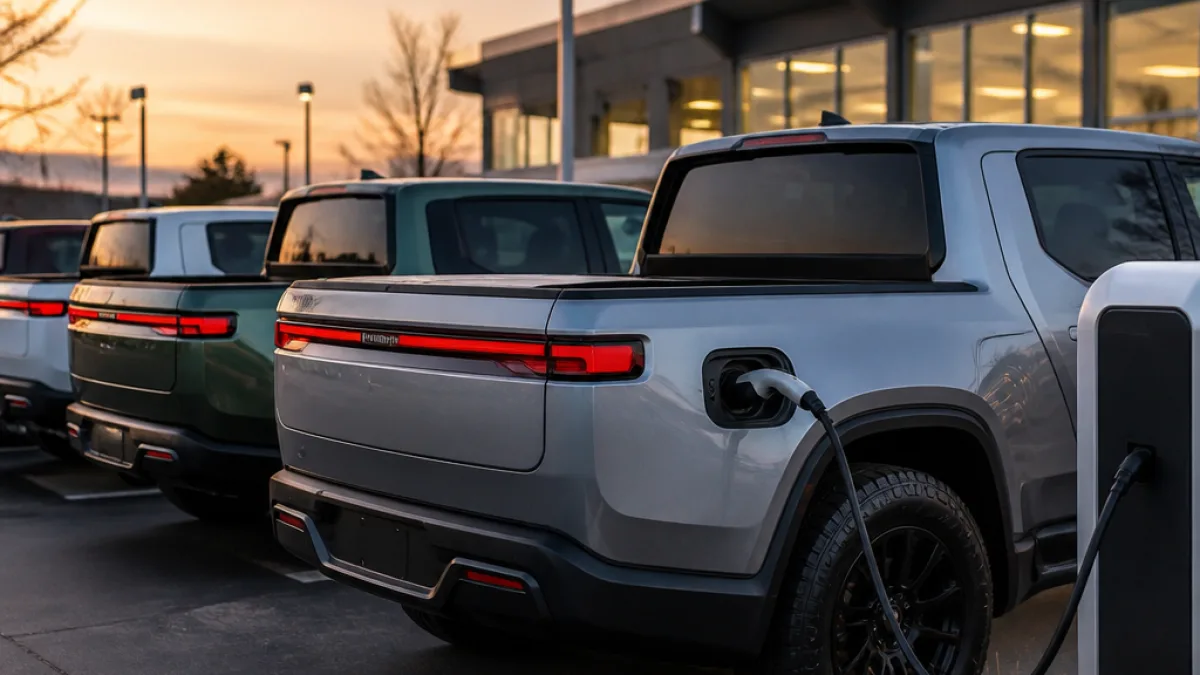
Used Ford F-150 Lightnings are moving off dealer and wholesale lots far faster than new electric vehicles, according to market data compiled by Cox Automotive and Recurrent Auto and summarized by industry analysts. The shift is producing a distinct resale market for the Lightning even as demand for new EVs softens.
Faster sales, firmer price floor
Pre-owned battery-electric trucks are selling in about 39.7 to 42.8 days of supply, the data show, while brand-new EVs are averaging 68 to 82 days of supply on dealer lots. That gap reflects a wider trend: used EVs are being bought at a daily pace of roughly 1,260 to 1,400 units nationwide, a rise of about 14% to 21% year over year. By contrast, the daily sales pace for new EVs has fallen roughly 30% to 61%, depending on the metric.
Why buyers favor used Lightnings
Analysts point to a combination of factors making the secondhand Lightning attractive to truck buyers: a lower entry price after initial depreciation, availability of useful features in earlier model years, and an intact factory battery warranty that transfers with the vehicle.
- Price stability: Many 2022 and 2023 Lightnings have settled into a perceived value band of roughly $31,900 to $45,000, providing a lower-cost path to electric truck ownership than $75,000-plus new stickers.
- Warranty protection: Used Lightnings carry Ford’s 8-year/100,000-mile factory battery warranty, which is automatically transferable and gives buyers reassurance about battery coverage.
- Value proposition: Early model years with practical ranges and features such as Pro Power Onboard make them useful to truck buyers at a lower cost.
Resale snapshot
Market averages and ranges compiled by Cox Automotive and Recurrent Auto show notable price clustering by model year.
| Model year | Average price | Reported range |
|---|---|---|
| 2022 | $39,600 | $28,999–$50,200 |
| 2023 | $43,150 | $31,900–$54,400 |
| 2024 | $54,347 | $35,995–$72,699 |
The data indicate that certified pre-owned, low-mileage 2024 Lightnings command higher prices, while earlier model years represent the lower entry points that many shoppers find compelling.
Industry metrics show a broader market divide: while new EV inventory stacks up on dealer lots, the used-electric supply chain has tightened as shoppers elect to buy secondhand units that avoid steep new-vehicle stickers and, in many cases, retain significant battery warranty coverage.
The figures cited come from Cox Automotive’s EV Market Monitor and Recurrent Auto’s used-EV reports, which aggregate wholesale and retail transactions, advertised listings and dealership inventories to measure sales velocity and pricing across model years.
Automakers, dealers and resale analysts continue to watch how incentives, financing rates and longer-term EV adoption will affect both new and used electric-vehicle markets in the months ahead.