Archaeologists working in northern Sudan have reached the original floor of a monumental medieval cathedral, offering a clearer sense of the scale of one of Nubia’s most important Christian buildings. The Polish-Sudanese mission made the discovery earlier this month at the ancient city of Old Dongola.
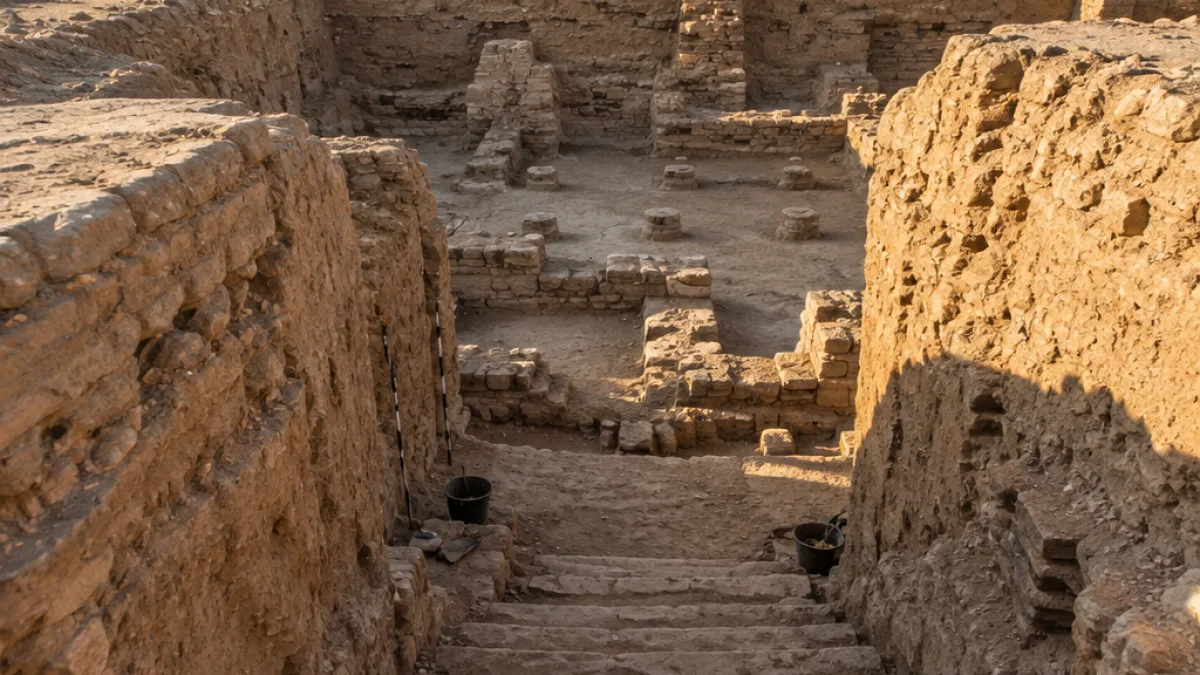
The team uncovered a staircase bordered by walls that rise 36 feet and descend to the church’s original floor level. Much of the structure remains buried, but the newly exposed passage has given researchers their first access to the floor since the building was identified in 2021.
The building, known as the Great Church of Jesus, is believed to have been the largest church in medieval Nubia. Archaeologists estimate that it measured about 154 feet wide and 187 feet long. Artur Obłuski, head of the Sudanese-Polish archaeological mission and director of the Polish Center of Mediterranean Archaeology, said the structure may have been larger than the White House.
“In the history of architecture, certain buildings emerge that, to use a modern term, become trendsetters. Hagia Sophia in Constantinople, modern-day Istanbul, is certainly one such example. The Great Church of Jesus appears to be a natural candidate for such a role in Nubia, and perhaps even in this part of Africa,” Obłuski said.
A major church in medieval Makuria
Old Dongola sits on the eastern bank of the Nile, about 100 miles southeast of modern Dongola. The city is known for its concentration of ancient churches and was part of Makuria, one of three kingdoms that emerged along the middle Nile after Christian missionaries arrived in the region during the sixth century.
Obłuski said the Great Church of Jesus was the largest and most important church in medieval Makuria. He compared its role in medieval Nubia and northeastern Africa with that of Hagia Sophia, the vast Byzantine church built under Emperor Justinian in 537, citing similarities in the buildings’ spatial planning and construction techniques.
The discovery has established several priorities for the continuing archaeological work:
- Excavate more of the church, which remains largely buried.
- Document the original floor and the high-walled staircase leading to it.
- Study the building’s layout and construction techniques in the context of medieval Nubian architecture.
The newly reached floor is significant because it provides physical evidence of the church’s original scale rather than relying only on portions of the structure visible above the ground. Further excavation is planned by the mission, which is examining the building as part of the broader history of Christian architecture along the Nile.