NASA’s second volunteer crew in the agency’s simulated Mars habitat is completing a 378-day mission Saturday, giving researchers another year of data on the practical demands of extended human stays away from Earth.
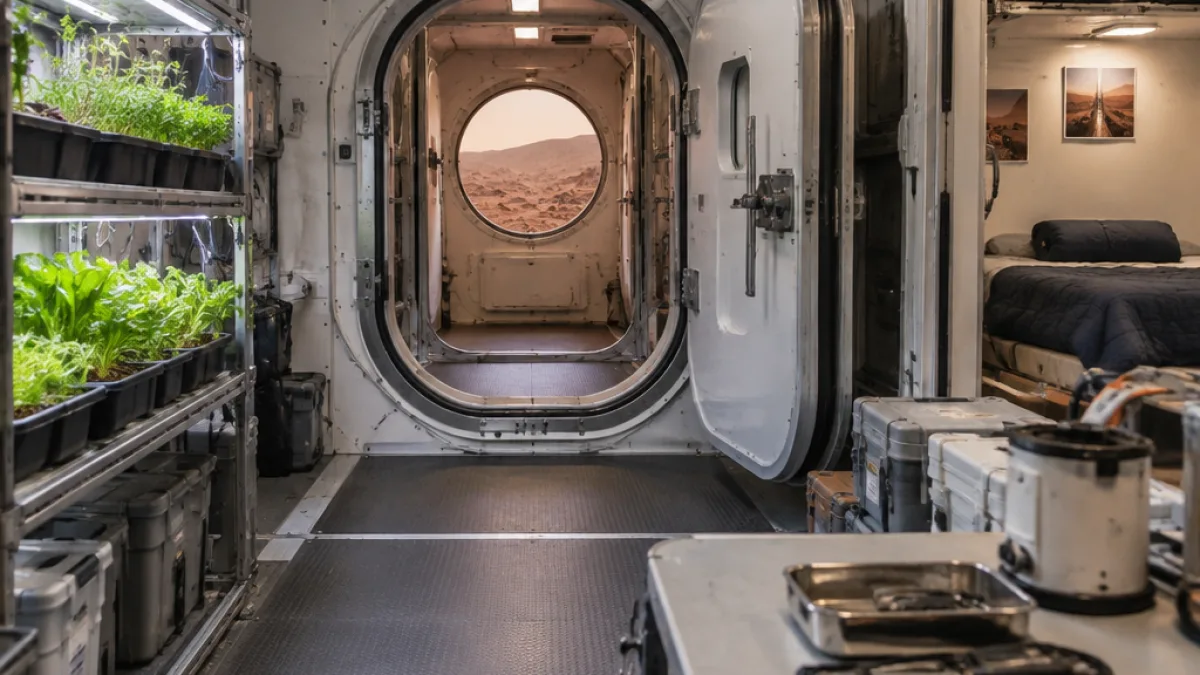
The four-person team — Ross Elder, Matthew Montgomery, Ellen Ellis and James Spicer — entered the facility at NASA Johnson in Houston on Oct. 19, 2025. The crew lived in a 1,700-square-foot structure designed to imitate conditions that astronauts could face during future missions to the moon or Mars.
Living under simulated Mars conditions
The mission was part of NASA’s Crew Health and Performance Exploration Analog, or CHAPEA, program. The participants carried out simulated exploration tasks while remaining on Earth, including mock spacewalks, maintenance of their habitat module and plant cultivation. They also used an airlock to enter and leave the simulated environment.
NASA designed the analog mission around challenges that could affect crews traveling far from Earth. Those conditions included isolation, delays in communication and restricted resources. The volunteers’ activities were intended to provide information about how people work and maintain daily routines during a long-duration mission in a confined habitat.
“The participants carried out simulated Mars mission operations on Earth.”
NASA is scheduled to livestream the crew’s departure from the habitat at 3 p.m. ET Saturday through the agency’s YouTube channel and social media accounts. The departure marks the end of the second CHAPEA mission, following the program’s first crew, which entered the simulator in June 2023.
NASA plans another analog mission
The agency has begun accepting applications for a new Moon and Mars Exploration Analog program. NASA says the effort will combine elements of CHAPEA with other simulation programs and is planned to begin no earlier than August 2027.
NASA says information from analog missions will be used to improve the design of food systems for future lunar missions and to prepare for prolonged stays in space. The program uses ground-based facilities rather than spacecraft, so its participants do not experience actual launch, microgravity or the full radiation environment beyond Earth.
- The CHAPEA Mission 2 crew spent 378 days in a simulated Mars habitat in Houston.
- Mission activities included mock spacewalks, habitat maintenance and growing plants.
- NASA’s next Moon and Mars analog program is planned to start no earlier than August 2027.