
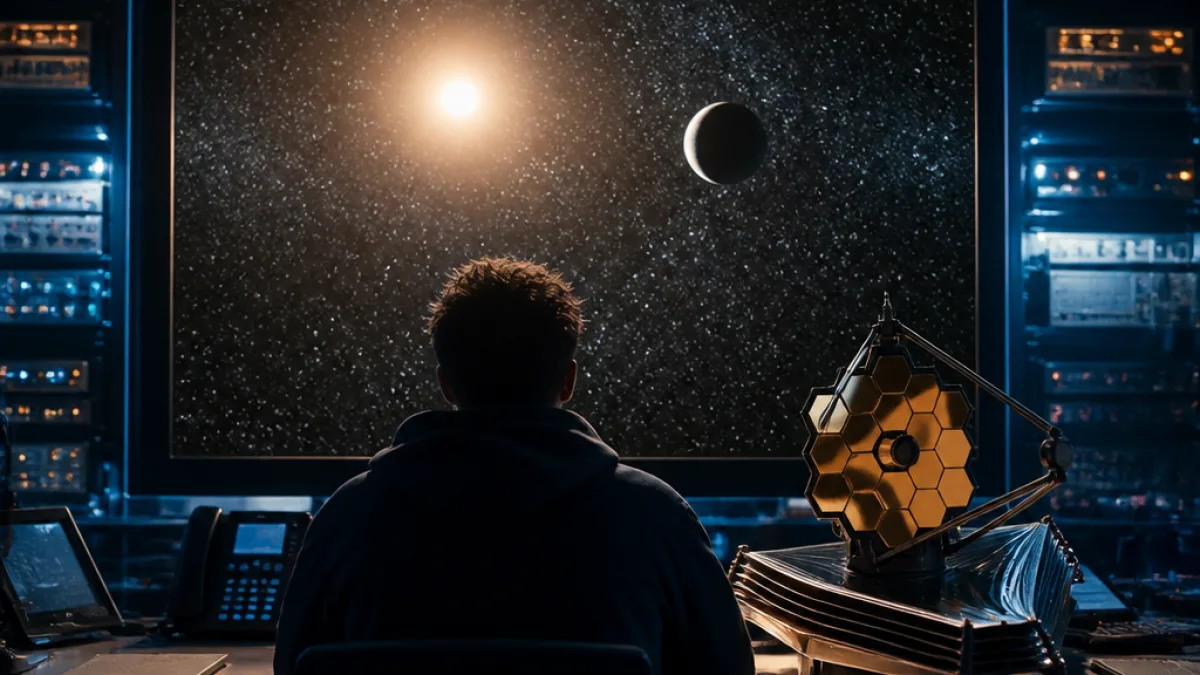
Astronomers using the James Webb Space Telescope have found that a scorching rocky exoplanet once thought too extreme to hold an atmosphere instead appears wrapped in a reflective layer that sends much of its star’s light back into space, researchers reported.
Observations and main findings
The team observed TOI-561 b, a so‑called lava world about 280 light years away, for 37 hours with JWST, covering nearly four orbits of the planet. Analysis published in The Astronomical Journal indicates the planet reflects a significant fraction of incoming starlight and shows evidence that heat is redistributed from the dayside to the nightside, which is consistent with the presence of a substantial global atmosphere.
- Planet type: rocky lava world orbiting close to its star
- Observation span: 37 hours, nearly four orbital periods
- Key inference: high reflectivity and signs of heat transport imply an atmosphere and reflective clouds
What could make the planet bright?
The researchers propose that bright silicate clouds above a magma ocean may be responsible for the strong reflection and cooling. Models explored by the team also allow for alternative atmospheric compositions, including a dense carbon dioxide layer like a superheated Venus or an atmosphere rich in sulfur dioxide, which could be supplied by intense volcanic activity on the planet or by an active satellite.
“Our discovery challenges current theories. We would expect a heavily irradiated rocky planet like TOI-561 b to have lost its atmosphere billions of years ago. Instead, the evidence suggests it still has a significant atmosphere today,” said Dr. Anjali Piette, assistant professor in astronomy at the University of Birmingham.
The paper highlights two broad possibilities for explaining the persistence of the atmosphere: either the planet began with an unusually large inventory of gases, or continuous outgassing from a molten surface replenishes the atmosphere. The data do not yet distinguish between those scenarios, and the exact chemical makeup of the atmosphere remains an open question, the authors say.
Implications and next steps
The finding runs counter to conventional expectations that highly irradiated rocky planets should be stripped of volatiles early in their histories by stellar radiation. The team notes that further spectroscopic observations will be required to identify molecular signatures and to test whether silicate clouds, carbon dioxide, sulfur dioxide or another composition best explains the observations.
Dr. Piette is a member of the international research group that reported the results in The Astronomical Journal. The study underscores JWST’s capability to probe the climates of small, ultra‑hot exoplanets and to reveal unexpected atmospheric phenomena on worlds very different from Earth.