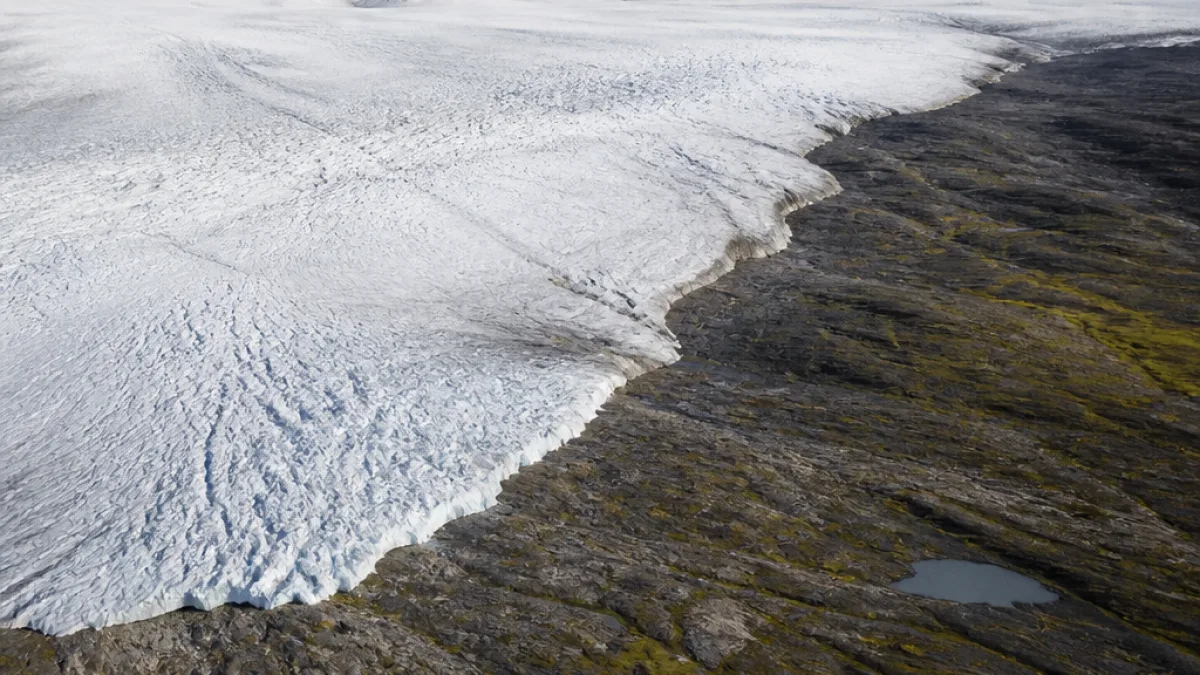
Earth’s next major glaciation had begun to take shape in the Arctic before human-driven warming interrupted it, according to a study published in the journal Science. Researchers reconstructed the history of the Barnes Ice Cap on Baffin Island in Canada and found that it began expanding roughly 2,000 years ago after reaching its smallest size.
The ice cap is the last remnant of the much larger Laurentide Ice Sheet, which covered broad areas of North America about 20,000 years ago. The sheet extended from the Arctic Circle as far south as Illinois and reached thicknesses of up to two miles in some areas. Today, the Barnes Ice Cap is about the size of Delaware and lies in Nunavut.
The researchers said the cap’s expansion was consistent with the beginning of a new period of glaciation. That process changed around 1960, when rising summer temperatures associated with human-caused climate change caused the ice to begin shrinking sharply. The findings connect a local record preserved in Arctic ice and rock to the longer orbital cycles that have driven repeated advances and retreats of ice sheets over millions of years.
“It was just getting started, everything was normal, the next glaciation was about to happen — and yet it stopped. It’s a very powerful example of how we have jolted the system.” — Nicolás Young
Young, a study author and geochemist at the Lamont-Doherty Earth Observatory, part of the Columbia Climate School, said the Barnes Ice Cap provided an unusual opportunity to examine a period that would otherwise be difficult to reconstruct. Ice can erase the geological evidence of earlier growth, but the Barnes cap is frozen to the bedrock beneath it and does not slide across the landscape.
Evidence preserved at the ice margin
Scientists collected long-dead mosses near the edge of the cap and determined when the plants had last been alive. As the ice expanded, it progressively covered and killed the mosses, creating a record of the ice margin’s movement. The team also examined nearby rocks for evidence of how long they had been exposed to the atmosphere.
That second analysis relied on a rare radioactive isotope that accumulates in rock after exposure to air. Together, the moss and rock measurements allowed the researchers to reconstruct the cap’s past:
- The Barnes Ice Cap reached its minimum size about 3,000 years ago.
- It began growing again roughly 2,000 years ago as temperatures cooled.
- Its expansion ended after summer temperatures rose around 1960.
Ice ages are linked to gradual changes in Earth’s orbit, which alter the amount and distribution of sunlight reaching the planet. The researchers used the Barnes record to examine whether the Laurentide Ice Sheet had once become smaller than it is now and later started growing again. Their reconstruction indicates that the ice cap had entered that early growth phase before modern warming reversed it.