Scientists at the Center for Astrophysics | Harvard & Smithsonian have developed Lumina, what the team describes as one of the largest cosmological radiation‑hydrodynamics simulations ever produced. Published in Monthly Notices of the Royal Astronomical Society, the model recreates how ordinary matter, dark matter and radiation interacted during the universe’s first 2 billion years and is designed to be compared directly with observations from the James Webb Space Telescope and the Nancy Roman Space Telescope.
Scope and computing
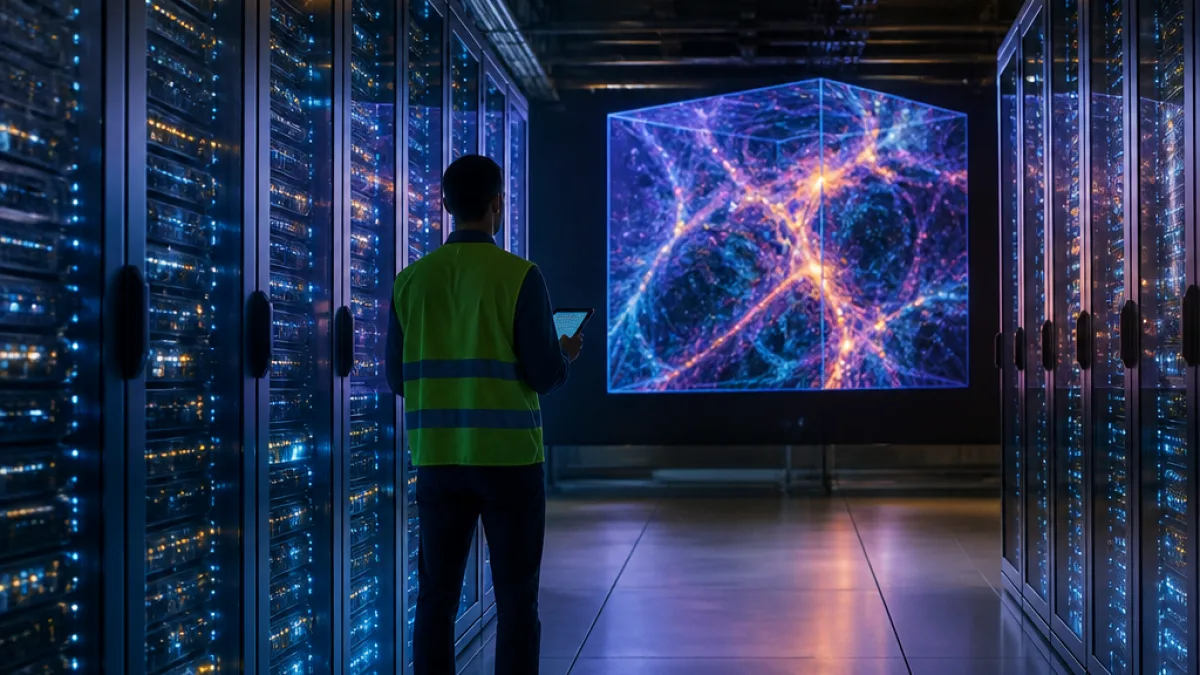
The simulation covers a volume the researchers say is more than 100 times larger than comparable previous models, represented as a cube roughly 1.5 billion light‑years on each side. The run employed more than 15,000 GPUs on the Frontier supercomputer to follow the coupled evolution of gas dynamics, radiation transport and gravity across that enormous volume.
What Lumina does
- Tracks the growth of structure from the immediate post‑reionization era through the first 2 billion years of cosmic history.
- Couples radiation transport with hydrodynamics so light from young stars and galaxies alters the state of surrounding gas in real time.
- Includes helium reionization and lets its consequences immediately affect later structure formation.
The team emphasizes that Lumina is the first simulation of this scale to capture helium reionization while allowing its effects to feed back on the evolving universe without delay. That is important because helium reionization changes the temperature and ionization state of intergalactic gas, which in turn influences how galaxies form and how light travels through space.
Links to observations
By generating a set of detailed, testable predictions for the distribution of galaxies, gas flows and radiation at early times, Lumina provides a platform for astronomers to compare theory with data from JWST, Roman and other observatories. The researchers say such comparisons can confirm where existing physical models succeed and where they may need revision.
Lumina’s large volume also helps with rare, bright objects: a bigger simulated box increases the chance of producing the kinds of massive, early galaxies that telescopes like JWST are now finding, enabling statistical comparisons between theory and observation that smaller simulations cannot provide.
The paper reporting Lumina appears in Monthly Notices of the Royal Astronomical Society, and the authors note the simulation will serve as a reference for studies of galaxy formation, the impact of radiation on cosmic gas, and the interpretation of emerging observational data.