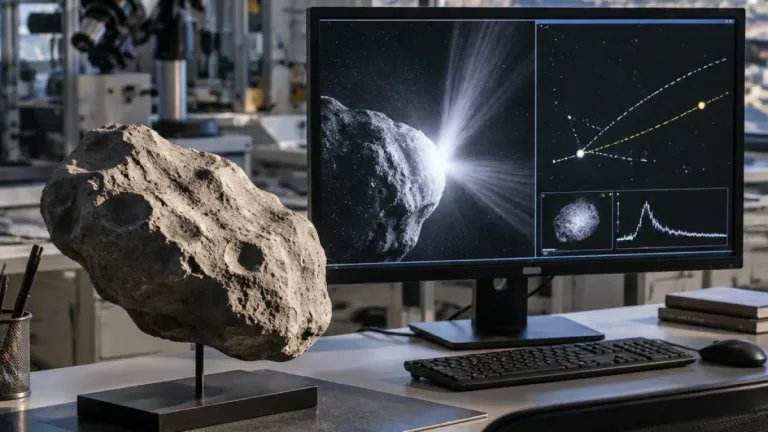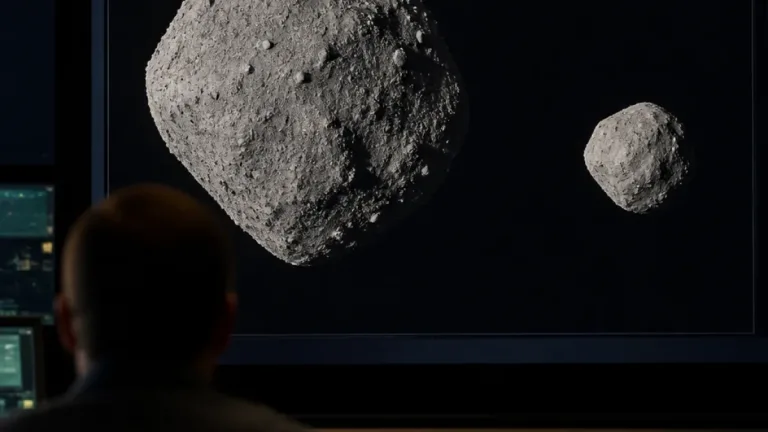
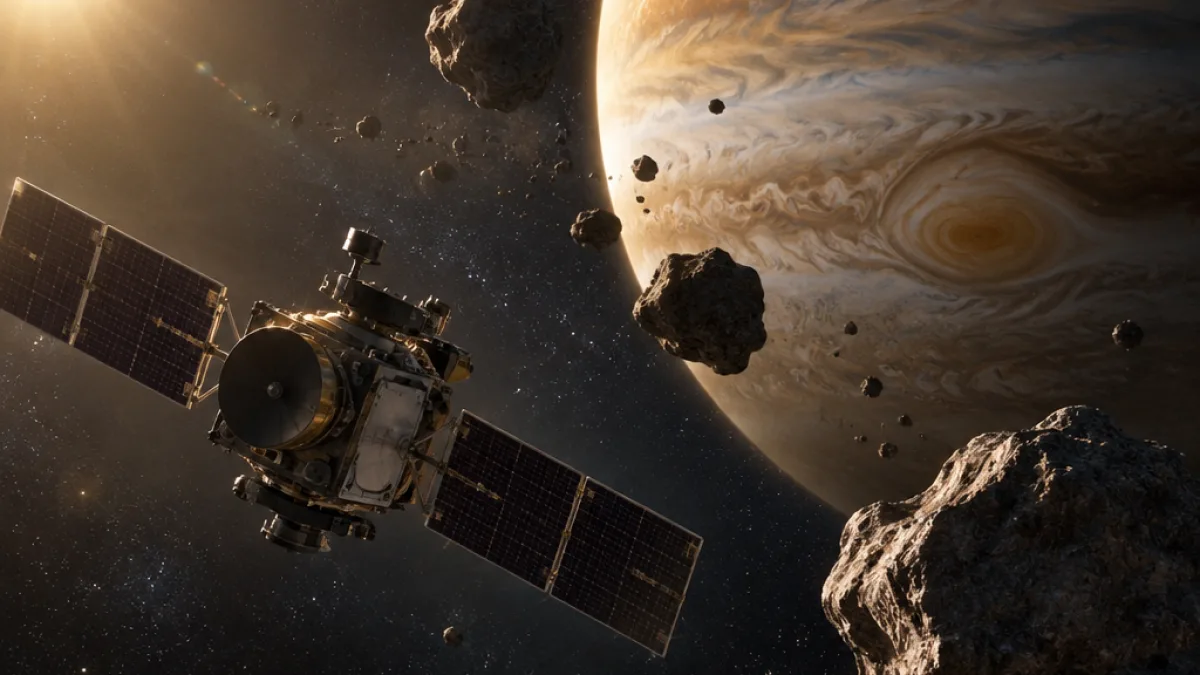
NASA’s Lucy spacecraft has become the first spacecraft to reach the Jupiter Trojan asteroids, a population of primitive solar-system bodies that travels around the sun along Jupiter’s orbit. The milestone came after Lucy spent about five years in space and covered 2.2 billion miles since its launch on Oct. 16, 2021.
Lucy is now approaching Lagrange point 4, the region ahead of Jupiter in the planet’s orbit where a large group of Trojan asteroids is concentrated. A second population occupies the corresponding region near Lagrange point 5, behind Jupiter. The two areas are held in place by the combined gravitational effects of the sun and Jupiter, creating stable orbital zones for the asteroids.
Scientists have described the Trojan populations as unexplored “islands of stability.” Several spacecraft have visited Jupiter or used the planet’s gravity to travel farther into the solar system, but none had previously conducted a mission specifically aimed at visiting the Trojan asteroids. Lucy was designed to survey objects in both groups.
“Since the two Trojan regions are separated from each other by more than 6 million miles on average, they will appear to Lucy as pinpricks of light moving against a field of stars until the spacecraft bears down on its chosen targets.” — NASA
Planned asteroid encounters
The spacecraft’s first close encounter with a Trojan asteroid is scheduled for Aug. 11, 2027, when Lucy is due to visit Eurybates. The mission’s announced sequence also includes Polymele in September 2027, Leucus in April 2028 and Orus in November 2028.
- Eurybates: the first planned Trojan encounter, in August 2027.
- Polymele: scheduled for September 2027.
- Leucus: scheduled for April 2028.
- Orus: scheduled for November 2028.
These objects are located roughly as far from Jupiter as Jupiter is from the sun, or about 484 million miles. Their distance from the planet and their positions in the two gravitationally stable regions make them difficult to reach with a conventional flyby mission. Lucy’s trajectory was built to move between the populations rather than remain limited to a single cluster.
After its planned Trojan observations, Lucy is expected to return to Earth in 2030 for a third and final gravity assist. NASA says that maneuver will send the spacecraft toward Jupiter’s trailing Trojan group, allowing the mission to continue its survey of both sides of the planet’s orbit.
The mission is intended to examine bodies that have remained in these orbital regions since the early solar system. The planned encounters will give scientists an opportunity to compare several Trojan asteroids and to study objects that have not previously been visited by a spacecraft.