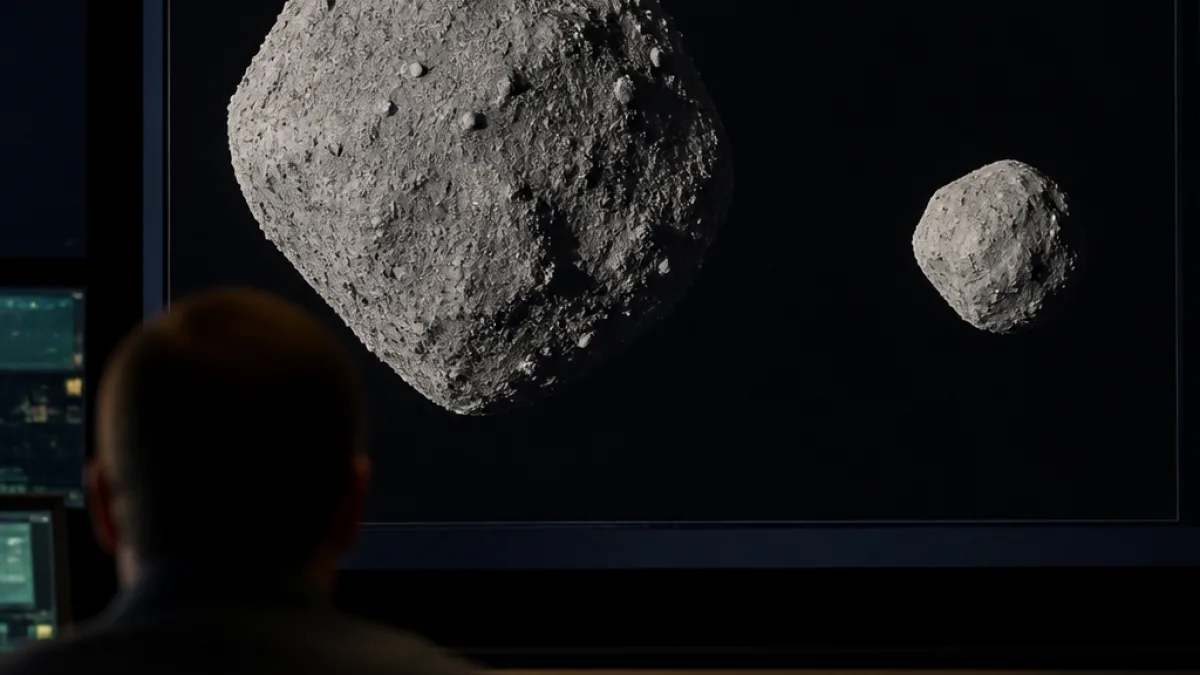
The European Space Agency’s Hera spacecraft has for the first time imaged the two components of the Didymos asteroid system separately, mission officials said, providing the first direct view of the small moonlet Dimorphos since NASA’s DART impact experiment in 2022.
Hera captured the image with its monochromatic Asteroid Framing Camera on the evening of Friday, Oct. 18, when the spacecraft was about 1,280 km (795 miles) from the pair, the agency said. The acquisition followed a set of braking maneuvers that slowed Hera to roughly 20 m/s (45 miles per hour) relative to the asteroids, allowing the spacecraft to approach on a fine-tuned trajectory.
“With this image the smaller Dimorphos asteroid becomes visible for the first time,” said Michael Kueppers, one of the mission scientists. “Before this acquisition the spacecraft was still resolving the Didymos system as a single dot. But now, even though Dimorphos is made up of only around one pixel in this initial image, it is clearly well separated from its parent body.”
Hera mission manager Ian Carnelli emphasized the milestone as the start of increasingly detailed observations. “For the first time we are seeing through Hera's own eyes the double asteroid system that the mission was designed and built for,” he said. The team said views will sharpen as Hera closes and that the first detailed images of Dimorphos will be unveiled on Nov. 25.
What the images show and why they matter
- The Didymos primary is about 780 m (2,560 feet) in diameter; Dimorphos is about 151 m (495 feet), roughly the size of the Great Pyramid of Giza.
- The two bodies orbit each other at an average separation of roughly 1.15 km (0.71 miles), with Dimorphos moving at about 18 cm/s (7.1 inches per second) around its parent.
- Dimorphos was the target of NASA’s Double Asteroid Redirection Test, or DART, which intentionally impacted the moonlet on Sept. 26, 2022, to change its orbit as a planetary defense experiment.
The Hera images mark the transition from cruise and approach operations to detailed reconnaissance. The mission’s earlier thruster firings, carried out a week apart, reduced relative speed and allowed a controlled, gradual close approach that preserves imaging geometry and navigation margins.
Scientists will use Hera’s forthcoming higher-resolution data to study the physical and structural consequences of the DART impact and to refine models of small-body mechanics and planetary defense techniques. The mission will also map surface features, measure mass and density, and characterize the binary system’s dynamics as Hera continues to approach.
As Hera closes, the mission team said public releases of images and measurements will continue on a schedule the agency has announced, with the next major image drop set for Nov. 25.