
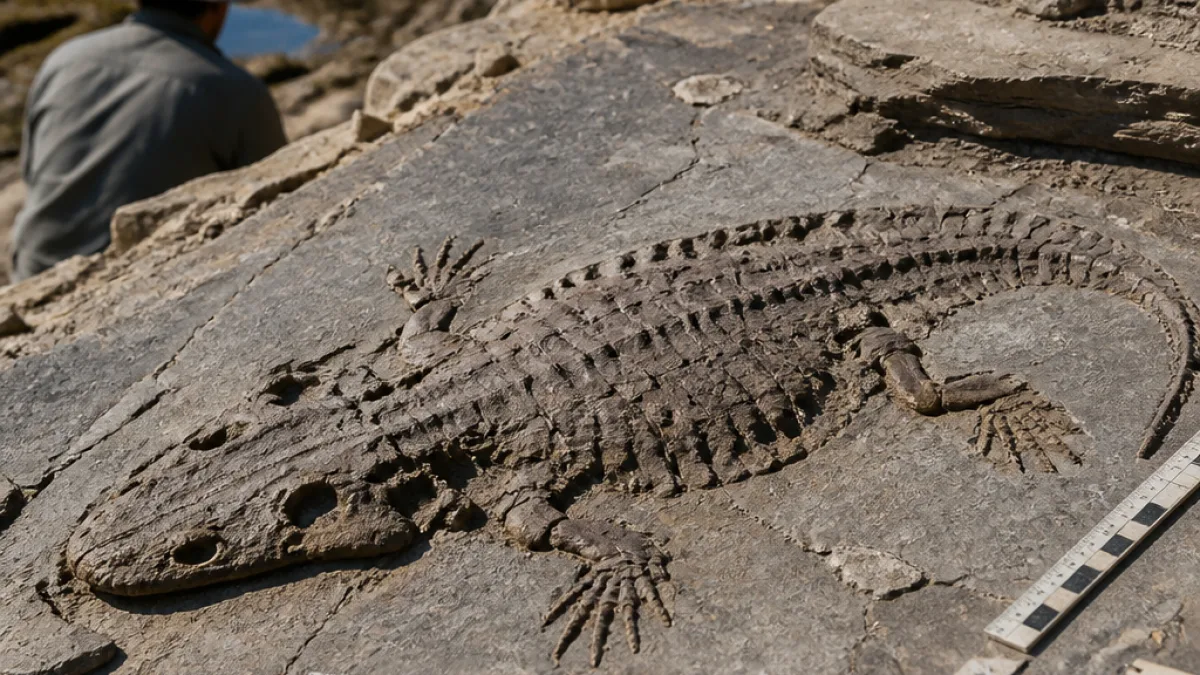
Scientists have identified fossil evidence of what they say is the first fully marine amphibian, a salamander-sized animal that lived about 237 million years ago and adapted to life in the open ocean, researchers reported Monday in the journal Nature Ecology & Evolution.
A chunky, armored swimmer
The animal, named Gerrothorax maritimus by the authors, is represented by two nearly complete skeletons recovered from Late Triassic marine rocks in Guizhou Province, China, an area that the team says was hundreds of miles from large land masses at the time. The specimens allowed the researchers to reconstruct the creature’s form and infer aspects of its ecology.
- Size and shape: The animal was almost three feet long with a flattened, disc-shaped body, the team reported.
- Bony armor: The body was covered in extensive dermal bone, which the authors interpret as a defensive adaptation and a factor that enabled marine living.
- Physiology and habitat: The researchers concluded the species was fully marine, unlike modern amphibians, which generally require freshwater and are largely intolerant of salt.
“If you think about today’s amphibians, this animal is unusual because it’s big,” Ryosuke Motani, a co-author and professor in the Department of Earth and Planetary Sciences at the University of California, Davis, said in a university news release.
“If you think about today's amphibians, this animal is unusual because it's big. It's probably, body mass-wise, about the same as the giant salamander, but what's different is that giant salamanders are elongated whereas this animal is really chunky.” — Ryosuke Motani, co-author and UC Davis professor
Study details and support
The paper, authored by researchers from UC Davis, Peking University in Beijing and the Geological Museum of Guizhou, appears in Nature Ecology & Evolution. The work was supported by the National Natural Science Foundation of China, the authors said.
The fossils come from a deposit that has yielded well-preserved marine reptiles and fish, the team noted. Those remains, together with the geological setting, informed the authors’ interpretation that G. maritimus lived in open-ocean conditions rather than in nearshore or brackish environments.
The researchers emphasize that modern amphibians are largely excluded from marine ecosystems because their permeable skin, used for respiration and water balance, does not filter salt. In contrast, the heavy dermal armor of G. maritimus may have provided protection from predators and played a role in osmoregulation or buoyancy that made sustained marine life possible, the paper states.
Context within the fossil record
The discovery expands the known ecological range of amphibian relatives in deep time. The authors contrast the new species’ compact, robust body plan with the elongated forms of some giant modern salamanders, arguing that the body shape and armor mark an unusual departure in the group’s evolutionary history.
The paper provides the anatomical description, comparative analysis with related fossils and the stratigraphic context that supports the Late Triassic age estimate of roughly 237 million years ago. The authors also discuss how the find fits with other marine vertebrate fossils from the same region.
The study was published online in Nature Ecology & Evolution