Children in the United States are spending more days at schools and child care centers while wildfire smoke is present in the surrounding air, according to a nationwide study that also found indoor pollution levels can remain high during smoke events.
Researchers examined air-quality data from more than 100,000 schools and 130,000 child care centers. The average number of school days affected by wildfire smoke increased from about seven in 2006 to 54 in 2023, the study found. At child care centers, the annual average rose from about nine days to 112 days over the same period.
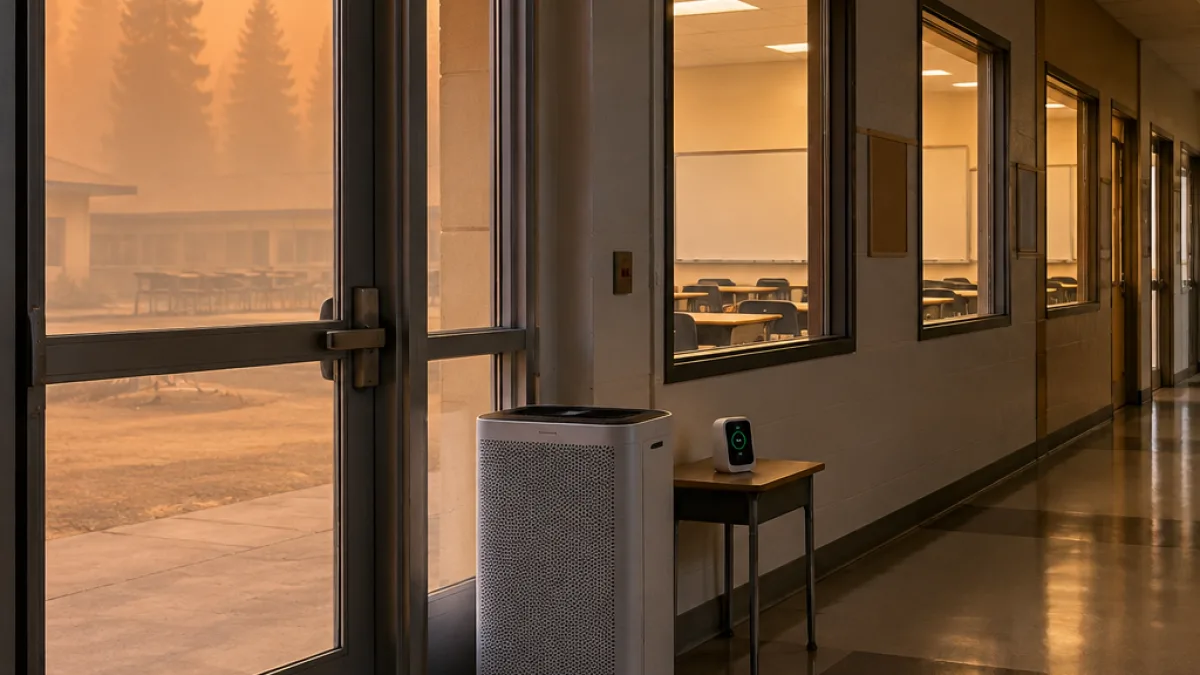
The researchers also compared indoor and outdoor air quality at 71 schools and child care centers in the West Coast region. Some buildings recorded higher indoor concentrations of fine particulate matter than nearby outdoor monitors during smoke days, said Molly Kile, an environmental epidemiologist at Oregon State University and a study co-author.
“Some schools had higher indoor PM2.5 concentrations than nearby outdoor measurements during smoke days,” Kile said.
Indoor air quality varied during smoke events
Wildfire smoke can travel thousands of miles and contains PM2.5, particles small enough to move deep into the lungs and enter the bloodstream. The findings indicate that being inside a school or child care center did not consistently prevent exposure during periods when smoke affected the surrounding community.
Stephanie Foster of Samaritan Health Services’ Research Development Office in Corvallis, Oregon, was the study’s lead author. She said educational facilities could reduce children’s exposure through coordinated planning, air-filtration systems, indoor-air monitoring and changes to activities during smoke events.
“We found that the buildings where children spend much of their day do not consistently protect them from air pollution,” Foster said. “But educational facilities are places where coordinated preparedness plans, air filtration, indoor air quality monitoring and changes to activities during smoke events could reduce exposure.”
Measures identified by researchers
The study authors identified improved ventilation and portable HEPA filters as measures that could help reduce indoor exposure to wildfire smoke. Their findings focused on air-quality conditions at educational facilities and did not evaluate a single smoke event or a particular wildfire.
- Average smoke-affected days rose from about seven to 54 annually at schools between 2006 and 2023.
- Child care centers saw an increase from about nine to 112 average smoke-affected days over the same period.
- Some West Coast facilities had indoor PM2.5 levels above nearby outdoor readings during smoke events.
The findings were released Nov. 3, 2026, by HealthDay News, which cited the researchers’ news release. The U.S. Centers for Disease Control and Prevention provides information on air pollution and wildfire smoke.