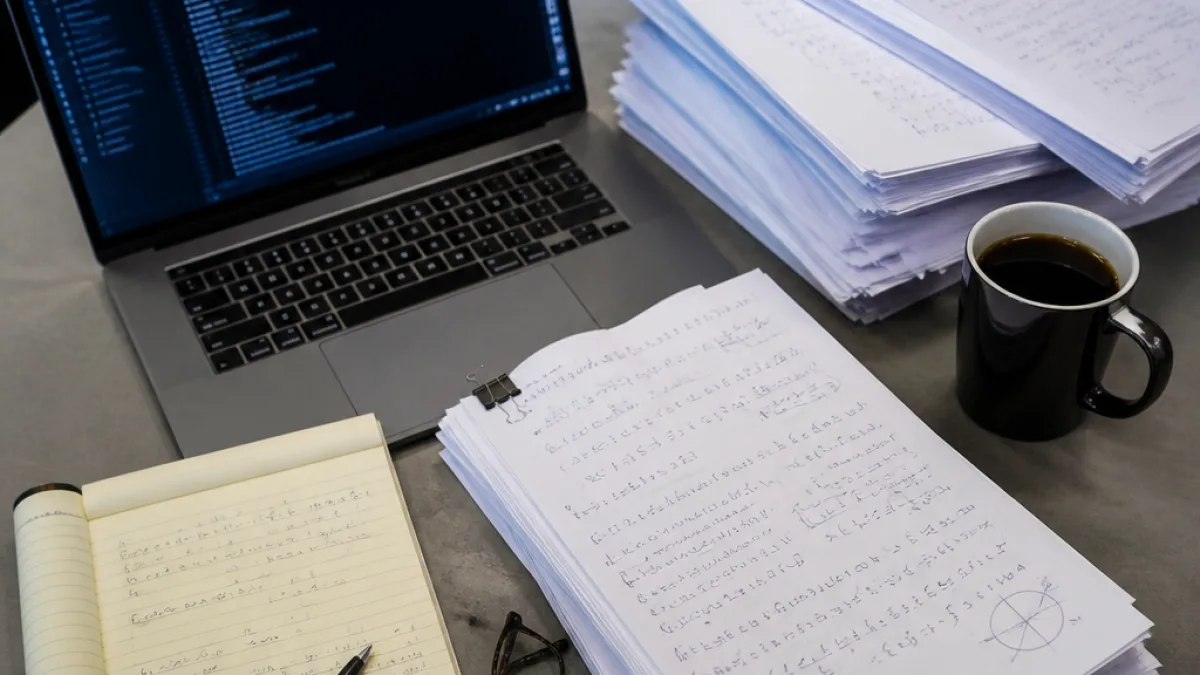
OpenAI said Tuesday it has released additional technical manuscripts describing advances across mathematics and computer science and announced related work in theoretical physics, expanding on an earlier rollout of hundreds of pages of solutions to math problems.
What OpenAI published and who will vet it
The company added two manuscripts to a GitHub repository: one that the company says establishes Sogge’s local smoothing conjecture for wave equations in every spatial dimension, and a second that presents a proof claiming the Exponential Time Hypothesis, or ETH, is false. ETH is a foundational assumption in complexity theory that underpins a large body of work in algorithms, databases, computational biology and geometry.
OpenAI said it had already made available large math results in a prior release — more than 700 pages covering progress and solutions for 372 major math problems — and that it is treating the new computer science and physics findings differently by involving external experts.
- For the computer science results, OpenAI convened an external group of collaborators and asked them to prepare independent writeups and explanatory materials while also publishing the AI outputs.
- For the physics materials, OpenAI deferred public release to an external team charged with examining those findings; the examining group has provided a contact email, YANGMILLS4D@gmail.com, for questions about its work.
“on how to broaden participation and make this process more useful,” OpenAI said as it invited feedback on the review process.
Background and implications described by OpenAI
OpenAI noted that ETH is widely believed to be true and has served as the basis for hundreds of scholarly papers. The company said the scientists who originally proposed ETH are part of the group it has asked to examine and explain the AI‑generated results. OpenAI also said the Sogge result addresses behavior of solutions to the wave equation, a central topic in partial differential equations and mathematical analysis.
OpenAI said it experimented with three different strategies for the releases: publishing the math results directly for researchers to inspect, forming an external group to vet and explain computer science outputs while also releasing the AI output publicly, and deferring physics materials to a separate external team for review prior to wider publication.
The company is soliciting commentary and said it welcomes suggestions about expanding participation and improving the review process. The manuscripts are available now on GitHub, according to OpenAI.
Independent verification and peer review will be required to assess the correctness and significance of the claims, particularly the assertion that ETH is false, because that hypothesis underlies many theoretical results and practical assumptions about algorithmic limits.
OpenAI provided a contact for questions about the physics examination team at YANGMILLS4D[@]gmail.com.