Voyager 1, the most distant human-made spacecraft, is nearing a milestone that will make communication with Earth slower than ever. NASA calculates that the probe will pass a distance of one light-day from Earth on Wednesday, meaning a radio message will need about 24 hours to travel between the spacecraft and the planet.
The crossing is expected at 5:16:07 a.m. ET, according to calculations cited by the Voyager program. The milestone comes nearly 49 years after the spacecraft launched on Sept. 5, 1977, and long after it completed its primary encounters with Jupiter and Saturn.
A mission built for the outer planets
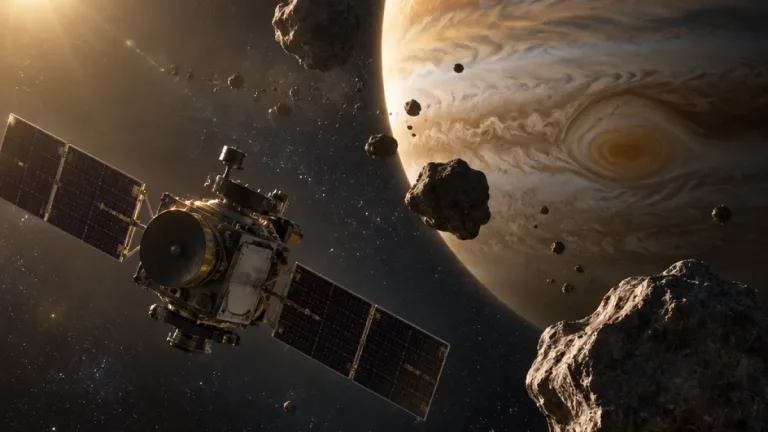
Voyager 1 and its twin, Voyager 2, were launched during a rare alignment of the outer planets. The arrangement allowed the spacecraft to use the gravity of the giant planets to alter their trajectories. NASA originally designed the mission to visit Jupiter and Saturn, while recognizing that the probes would then be sent beyond the solar system.
The spacecraft also carried a deliberate message for any distant civilization that might someday find it. A golden record contains a representation of life on Earth, an idea whose design was led by astronomer Carl Sagan. Before launch, Sagan described the record as a hopeful statement about life on the planet.
“I never imagined the mission would last this long,” Linda Spilker, the current chief scientist of the Voyager program, said.
Spilker was working at NASA’s Jet Propulsion Laboratory when Voyager 1 left Earth. She later worked on the Cassini mission, which studied Saturn, its moons and its rings from 1997 to 2017. Voyager 1’s continued operation has far exceeded the expectations associated with a spacecraft built with technology that is extremely limited by modern standards.
Computing power measured in kilobytes
The six computers aboard the two Voyager probes together contain only 68 kilobytes of memory. That capacity is smaller than the storage found in many ordinary household appliances today. The probes’ computers were designed for the systems and scientific instruments of the 1970s, not for the volume of data or communication speeds expected from a modern spacecraft.
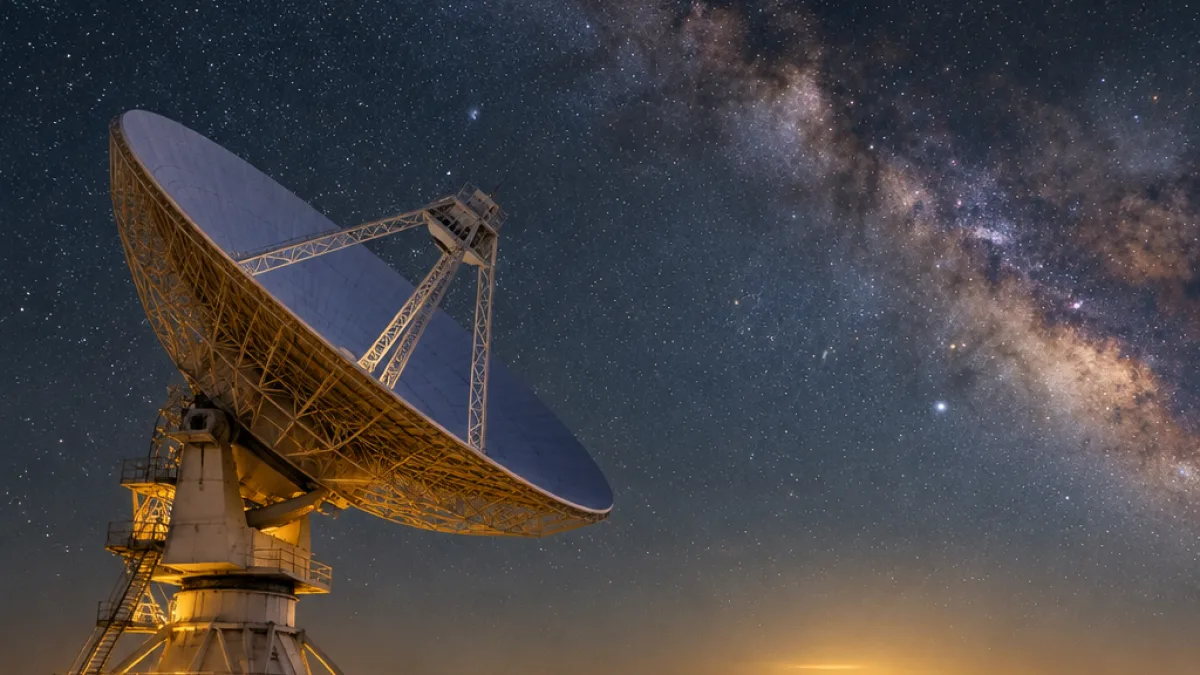
Communicating with Voyager 1 now requires patience because of both the spacecraft’s distance and its limited computing systems. Commands and responses take longer to complete as the probe travels farther away. Even so, Voyager 1 continues to send measurements from interstellar space, a region beyond the protective bubble created by the sun that no earlier human-made spacecraft had explored.
- Launch: Sept. 5, 1977
- Milestone: One light-day from Earth
- Expected crossing: 5:16:07 a.m. ET on Wednesday
- Onboard computing: 68 kilobytes across six computers on the twin probes
The one-light-day milestone will not mark the end of Voyager 1’s journey. The spacecraft was built to continue outward after its planetary encounters, carrying its scientific instruments and the golden record into the space between stars. Its longevity has turned a mission planned around a brief tour of the outer planets into a decadeslong record of exploration beyond the solar system.